
How Nonprofits Can Avoid Common IRS Penalties and Protect Their Tax-Exempt Status
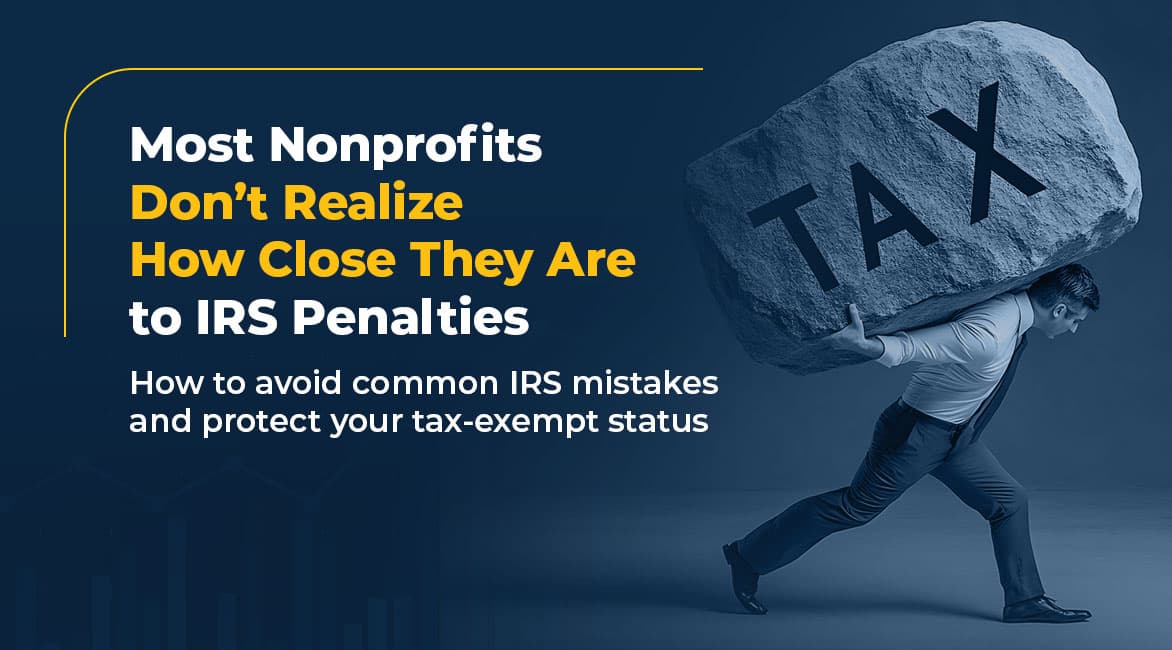
Did you know that failing to file a required IRS information return for three consecutive years automatically strips your nonprofit of its tax-exempt status? That’s not an abstract risk—it’s a statutory consequence under Internal Revenue Code Section 6033(j).
Many nonprofit leaders assume IRS penalties are only for egregious misconduct or large organizations. In reality, simple administrative oversights like late filings or incomplete schedules can trigger daily fines, jeopardize your organization’s legal standing, and erode donor trust. For example, if your nonprofit fails to file a Form 990 on time—even with an extension—you may owe per-day fines that can add up into the tens of thousands, especially for larger organizations with higher annual receipts.
Even more alarming: if you miss filing required returns for three years in a row, the IRS will automatically revoke your tax-exempt status—without a notice, without a hearing, and without an appeals process.
In this guide, you’ll learn exactly which IRS penalties nonprofits face, what triggers them, and practical, proven strategies you can implement to avoid them entirely. By the end, you’ll have a compliance playbook that protects your mission, finances, and long-term sustainability.
IRS Penalties for Nonprofits Explained — What You’re Really Up Against
Before you can prevent penalties, you need to understand what they are and why they matter to your nonprofit.
Daily Fines for Late or Incomplete Filings
If your nonprofit files its annual Form 990, 990-EZ, or 990-PF late or fails to include all required schedules, the IRS can impose a penalty of $20 per day for each day the return is late. The maximum penalty generally equals the lesser of $10,500 or 5% of your organization’s gross receipts for that year.
For larger organizations with gross receipts above the IRS threshold (e.g., over ~$1.09 million in recent filing years), the per-day penalty rises to about $105 per day, with maximums exceeding $54,000.
Automatic Revocation for Non-Filing
Missing required filings for three consecutive years triggers automatic revocation of your tax-exempt status—period. There is no appeal of an automatic revocation itself.
Once revoked, your nonprofit loses federal tax exemption, may owe corporate income tax, and gifts to your organization may no longer be tax deductible for donors.
Responsible Party Penalties
If required filings are inaccurate or incomplete, responsible individuals may incur additional daily fines (e.g., $10 per day up to statutory limits).
Avoiding Form 990 Compliance Pitfalls That Trigger Penalties
Your annual Form 990 is the compliance centerpiece for your nonprofit. Getting it wrong is by far the most common cause of IRS penalties—even when your mission and finances are sound.
The Most Common Form 990 Mistakes
Here are the errors that most often lead to penalties:
-
Filing the wrong version of the form
Small nonprofits often file Form 990-N (e-Postcard) when a full Form 990 or 990-EZ is required.
-
Missing schedules or incomplete information
Schedules related to contributors, governance, compensation, and related parties must be filed when applicable.
-
Inaccurate financial reporting
Numbers that don’t reconcile with audited or internally prepared financials can invite IRS scrutiny and penalties.
-
Failing to include narrative responses
Parts of Form 990 require written explanations of program accomplishments—omitting these can be just as problematic as missing dollars and cents.
-
Incorrectly classifying income categories
Revenue must be broken out by type (e.g., contributions vs. program revenue). Misclassification invites questions or potential penalties.
Proven Systems to Prevent Compliance Errors
To avoid these common mistakes:
-
Maintain Real-Time Financial Records
Waiting until year-end invites errors. Regular reconciliation and documentation help ensure accuracy.
-
Build a Pre-Filing Review Process
Have at least two people independently check your 990 before submission.
-
Reconcile to Your General Ledger and Audited Statements
If the numbers don’t tie exactly, IRS systems and reviewers will flag inconsistencies.
-
Use Checklists for Required Schedules
Keep an indexed checklist of which schedules apply based on your nonprofit’s activities and financial metrics.
-
Educate Your Accounting Team
Nonprofit tax compliance knowledge is specialized; make sure anyone handling your 990 understands its nuances.
How Late Filings and Automatic Revocation Put Your Tax-Exempt Status at Risk
One of the most critical IRS penalties you must avoid is the automatic revocation of tax-exempt status due to non-filing.
Late Filings Lead to Costly Daily Penalties
If you file your annual return late, even with a timely extension, you will incur daily fines until the IRS receives a complete and accurate return.
It’s important to note that filing requirements vary by the size and type of your organization, and the penalties can scale with your gross receipts.
What Automatic Revocation Actually Means
Under federal tax law, if your nonprofit fails to file any required Form 990 series return or notice for three consecutive years, your tax-exempt status is automatically revoked as of the due date of the third unfiled return.
Once revoked:
-
Your nonprofit becomes subject to federal income tax.
-
Donors can’t claim tax deductions for new contributions.
-
You may lose eligibility for grants and partnerships that require verified exempt status.
Reinstating Tax-Exempt Status
Although reinstatement is possible, it’s time-consuming, requires back filing delinquent returns, and may involve significant administrative burden.
The bottom line: consistently meeting annual filing requirements is non-negotiable if you want to protect your nonprofit’s tax advantages and long-term viability.
Avoiding Payroll Tax and Worker Classification Penalties in Nonprofits
Payroll compliance is one of the fastest ways IRS penalties escalate for nonprofits—and one of the most misunderstood.
Even though your organization is tax-exempt, payroll taxes are not optional. The IRS treats payroll noncompliance seriously because it involves trust fund taxes withheld from employees.
Common Payroll-Related IRS Penalties You May Face
Nonprofits frequently incur penalties due to:
-
Late or missed federal payroll tax deposits
-
Failure to file Form 941 on time
-
Incorrect or late W-2 and 1099 filings
-
Misclassifying employees as independent contractors
According to IRS guidance, employment tax penalties apply regardless of nonprofit status, and interest accrues from the due date of the unpaid tax.
Worker misclassification is particularly risky. If the IRS determines that a contractor should have been treated as an employee, your nonprofit may be liable for back taxes, penalties, and interest.
How You Can Prevent Payroll Compliance Issues
To reduce risk:
-
Reconcile payroll taxes monthly—not quarterly
-
Review worker classifications annually using IRS criteria
-
Separate payroll processing from general bookkeeping
-
Maintain clear documentation for compensation decisions
Payroll penalties compound quickly, but systematic oversight and accurate recordkeeping significantly reduce exposure.
Excess Benefit Transactions and Governance Red Flags the IRS Watches Closely
Governance failures don’t just undermine public trust—they can also trigger severe IRS penalties.
What Is an Excess Benefit Transaction?
An excess benefit transaction occurs when your nonprofit provides unreasonable compensation or financial benefits to an insider such as an executive, officer, or board member. This includes:
-
Paying above-market compensation
-
Providing personal use of nonprofit assets
-
Engaging in undisclosed related-party transactions
Under Internal Revenue Code Section 4958, insiders involved in excess benefit transactions may face excise taxes, and organizational managers who approve them can also be penalized.
Governance Weaknesses That Increase IRS Scrutiny
The IRS closely reviews governance disclosures on Form 990. Red flags include:
-
No written conflict-of-interest policy
-
Lack of independent board oversight
-
Undocumented executive compensation decisions
-
Inconsistent or missing governance disclosures
The IRS has publicly stated that strong governance reduces the likelihood of non-compliance and abuse.
Practical Steps to Reduce Governance Risk
To protect your organization:
-
Benchmark executive compensation using independent data
-
Document board approvals in meeting minutes
-
Require annual conflict-of-interest disclosures
-
Review governance policies annually
Strong governance is not just the best practice—it’s a compliance safeguard.
Poor Recordkeeping and Documentation Failures That Lead to IRS Penalties
Inadequate documentation is one of the most preventable causes of IRS penalties, and one of the most common.
Documentation Gaps That Put You at Risk
The IRS expects nonprofits to maintain accurate, accessible records. Penalties often arise from:
-
Missing donation records or donor acknowledgments
-
Inadequate substantiation of expenses
-
Poor tracking of restricted vs. unrestricted funds
-
Inconsistent financial records across reporting periods
The IRS explicitly requires contemporaneous written acknowledgments for certain charitable contributions. Failure to maintain them can create compliance and donor-relations issues.
How Strong Recordkeeping Prevents Penalties
Effective documentation systems include:
-
Monthly bank and account reconciliations
-
Centralized digital storage of financial records
-
Clear audit trails for grant and restricted funds
-
Periodic internal reviews of financial controls
When records are incomplete or inconsistent, errors often spill into Form 990 filings—compounding risk. Accurate, timely documentation ensures your reporting reflects reality and withstands scrutiny.
How Proactive Accounting Systems Help You Avoid IRS Penalties Before They Happen
IRS penalties rarely result from a single mistake—they stem from systemic breakdowns in financial oversight.
Why Reactive Compliance Fails
When compliance is treated as a once-a-year task:
-
Errors go unnoticed until filing deadlines
-
Financial inconsistencies accumulate
-
Staff or volunteers scramble under pressure
-
Critical deadlines are missed
The IRS emphasizes internal controls and accurate financial reporting as key elements of nonprofit compliance.
What Proactive Accounting Looks Like
A proactive approach focuses on:
-
Ongoing transaction review and reconciliation
-
Early identification of reporting issues
-
Built-in compliance checkpoints
-
Clear separation of duties
Many nonprofits reduce penalty risk by adopting outsourced accounting and bookkeeping models, which provide specialized expertise, consistency, and continuity—especially where internal resources are limited.
Rather than reacting to IRS notices, proactive systems allow you to prevent compliance issues altogether, protect your tax-exempt status, and focus your energy on mission delivery instead of remediation.
IRS Penalty Prevention Checklist Every Nonprofit Should Follow
Avoiding IRS penalties isn’t about reacting faster—it’s about building repeatable compliance habits. Use this checklist to reduce risk across the entire fiscal year.
Nonprofit IRS Compliance Checklist
Review and implement the following:
-
File the correct Form 990, 990-EZ, or 990-N every year by the IRS deadline
-
Track filing deadlines and extensions in a centralized compliance calendar
-
Reconcile bank accounts and general ledger monthly, not annually
-
Review payroll tax deposits and Form 941 filings each quarter
-
Verify worker classifications using IRS criteria annually
-
Maintain contemporaneous donor acknowledgment records for contributions
-
Document board approvals, compensation decisions, and conflicts of interest
-
Separate restricted and unrestricted funds in your accounting system
-
Conduct internal financial reviews before year-end reporting
The IRS consistently emphasizes that strong internal controls and accurate records are foundational to nonprofit compliance.
Following this checklist won’t just help you avoid penalties—it will also strengthen transparency, governance, and long-term sustainability.
IRS Compliance Isn’t About Fear—It’s About Protecting Your Mission
IRS penalties don’t usually result from bad intentions—they result from missed details, weak systems, and reactive processes.
When filings are late, payroll records are inconsistent, or documentation is incomplete, the risk isn’t just financial. You place your tax-exempt status, donor confidence, and grant eligibility in jeopardy.
The reality is that most penalties nonprofits face are entirely preventable. By understanding your obligations, maintaining accurate records, and adopting proactive financial oversight, you significantly reduce exposure to IRS enforcement actions.
Compliance should never feel like a last-minute scramble. When your accounting and bookkeeping processes are structured, consistent, and reviewed year-round, IRS requirements become a natural outcome—not a looming threat.
Protecting your nonprofit’s mission starts with protecting its compliance foundation.
Avoid IRS Penalties Before They Cost You—Get Expert Nonprofit Accounting Support Now
If you want to reduce IRS penalty risk, safeguard your tax-exempt status, and stay audit-ready year-round, working with a specialized nonprofit accounting partner can make all the difference.
PABS provides outsourced bookkeeping and accounting services designed specifically to support nonprofit compliance, accuracy, and financial transparency—so you can focus on impact, not IRS notices.
Talk to PABS today and take control of your nonprofit’s IRS compliance before penalties arise.
Published on:

Author
John Bugh
John Bugh is the Chief Revenue Officer for Pacific Accounting and Business Services (PABS), responsible for the strategic direction, planning, vision, growth, and performance of the company’s marketing, branding, and revenue streams.
You might also like:
- Master Reporting for Nonprofits to Strengthen Your Mission in 2026
- What Is an In-Kind Donation? How Nonprofits Value, Record, and Report Non-Cash Contributions
- Financial Forecasting for Nonprofits: How Economic Uncertainty Is Driving Long-Term Stability
- Nonprofit Financial Management Built on Trust and Transparency